Saturday, March 7, 2015

Relocating & Redesigning

FOUNDATION BY ROUNDS

foundationbyrounds.tumblr.com

I started this blog here because I was familiar with the platform, but, since I've very much enjoyed writing it, I started looking around for more visually pleasing and easier to use tools this weekend. I found the platform I was looking for in Tumblr, and you will find my writing there from now on.

Monday, February 23, 2015

Instilling Creativity

Jeff Carter - Hyde Park Angels

Can You Build Creativity and Innovation Into Your Company?

(original post from Carter's blog)

Innovation is a widely acknowledged problem area for large organizations. Countless books and articles have been written on how to maintain the innovation that brings a company to life, and many solutions have been suggested. Eric Ries goes so far as to suggest large organizations create micro-startup divisions to drive innovation that are insulated from standard oversight. Most people don't go this far, and simply suggest that we build incentives for experimentation and, to some extent, allow for an enlightened model of failure that doesn't punish employees who think outside the box.

In this post Carter refers to a Harvard Business Review article on innovation within corporations (which references this academic paper) to make the following points:

  1. Provide financial incentives for new ideas that are implemented
  2. Work in small groups
  3. Give feedback on ideas that are used
And, Carter adds, don't criticize failure.

Carter's conclusion: This is how you drive innovation in a company, large or small.

Takeaway: Financial incentives to new ideas add a new level of gravitas. When people realize they're going to be taken seriously, they put more time and effort into an idea before presenting it to leadership. Small groups and quick feedback loops allow for a higher level of information gathering and adaptability, which drives innovation. And, finally, while failure itself is not good, it should be allowed when prepared for adequately. 

Sunday, February 15, 2015

Funding: Is Money a Commodity?

Jeff Carter - Hyde Park Angels

Can The Wrong Investors Screw Up Your Company?

(original post on Carter's blog)

An angel investor, Carter has significant experience with early and seed stage ventures. In this post he addresses a tough issue in the startup world, "Who should we accept money from?". This is a difficult question, especially for first time entrepreneurs with little or no knowledge of how funding should work.

Key Points:
  • Some people say that money is a commodity; that it doesn't matter where it comes from. I disagree.
  • Especially at an early stage investors should bring value to the table as mentors.
  • Beware of investors that may exert too much control over the venture.
  • Don't court any single for too long (more than a couple months).
  • Are they ethical?
  • Research their involvement with other companies.
Carter's Conclusion:
Be aware of who's money you're taking. Intuit once took a lower valuation from one VC instead of getting a higher valuation with another because they felt that the first was a better mach for their culture.

Takeaway:
When you get involved with an investor you need to be aware of what the relationship is going to be like. Money always has strings attached, and that can be a very good or a very bad thing. Ideally you will be able to find an investor who understands the company and has a vision for it that aligns with yours. Always do your best to understand the relationship you'll have with an investor before you take their money.

Dapps, Crowdsales, and App Coins done right

William Mougayar

Best Practices in Transparency and Reporting for Cryptocurrency Crowdsales


*Mougayar recently wrote an article on the frail bitcoin startup ecosystem. This prompted a response from Fred Wilson in which he references Perez's innovation framework of surges and crashes. In this 3rd post in the series Mougayar clarifies his position and provides particular insight into the world of Dapps (distributed applications) and the modern crowdsale.

Assembly is currently, I think, headed in the right direction for pioneering the practical future of Dapps/DAOs. The system works by assigning valuations in App Coins (essentially equity) to particular tasks for the public to accomplish (i.e. designing the logo, building the backend, etc). I think there's a pretty huge legal grey area here that will likely need to be addressed at some point. For now, go check it out, it's REALLY cool, and there are lots of products that could use some assistance. 

(original post on Mougayar's blog)

Key Points:
  • DAO's would probably be considered companies under today's law, even if they don't fit the definition perfectly.
  • Before Funding: White papers are cool, but they tend to be weak on implementation details. To gain credibility organizers need to:
    • communicate implementation details to the community
    • outline credentials and experience of the founders
    • essentially: build a public pitch deck
  • During Funding: This is the mechanics of the crowdsale itself. Here we address the issuing of tokens, wallets, shares, etc.
    • An independent foundation, not the founders, should handle funds.
    • Be transparent. Natural virality is best. Be transparent.
  • Development: The scary stage when the company goes dark for a year and builds the product they claimed they would.
    • Issue monthly transparent reports that include everything.
    • Blog posts are good if they have substance
    • Link between token and value of Dapp needs to be very clear
    • begin thinking about system partners
  • Market Entry: In spite of the name, you're not going to be autonomous yet.
    • Development should have prepped you to some extent for this stage, but you'll still need to be involved in a guiding role at least.
    • You need profits for this to work
Mougayar's Conclusion: This blog post is primarily directed at those individuals currently involved in crowdsales, premines, and the like. You need to be careful and aware of the impact your actions have on confidence in the market and in the broader economy. What you're doing is essentially making yourself a public company from day one, and that's no easy task.

Takeaway: While this post is directed at those already involved in the system of crypto-crowdsales, it should serve as a lesson to all entrepreneurs. We need to be as open as possible with all those involved in our endeavor. Whenever someone invests something in your venture, be it time, money, code, whatever, you are obliged to provide them with an open look into your stewardship of their resources. As a startup, be open with your investors. As a premine or crowdsale project, provide clear progress reports to your backers. As a public company (essentially what these crowdfunded projects are), be open with everyone. Be honest, be humble, work hard.

Wednesday, February 11, 2015

How (and why) to Make a Phone Call

Mark Suster - Upfront Ventures

It’s Sofa King More Effective to Pick up the Phone

Suster joined Upfront Ventures as a general partner in 2007. Prior to that he was an entrepreneur (twice) and sold his most successful venture, Koral, to salesforce.com. In addition to his VC work, Suster mentors at Techstars.

Key Points:
  1. Millennials hate phone calls. They prefer the ability to asynchronously pull together thoughts in an email.
  2. Text is tone deaf. Phone calls are effective in conveying meaning and emotion.
  3. Here's how to do a phone call right:
    • Prepare - know your key points and the reason you're calling
    • Banter is good - Base the amount on the person you're calling.
    • Let them know why you're calling - "Listen, the reason I called is..."
    • Don't "hang yourself" - Don't talk so much they lose focus and start writing an email.
    • Ask questions - Keep them engaged, but don't be an interviewer
    • Take notes - Especially important in negotiations
    • Seek understanding first in tense situations - Listen, understand, then speak
    • Don't be long winded - You'll have a harder time scheduling calls if you're known to be a time sink.
Suster's Conclusion:
Stop hiding behind emails when you should be calling people. Calls are a tool that allow for another layer of communication, and you shouldn't neglect them.

Takeaway:
My generation has grown up with instant text communication as the norm. The abruptness of a phone call makes us uncomfortable when we're so used to being able to carefully craft our communications before we send them. The level of interaction that vocal communication provides should not be neglected. Emotional cues provided vocally help us better understand the people we interact with, and Suster's checklist (#3 above) does an excellent job of preparing people who may not be used to phone communication for doing so effectively.

Why Founders shouldn't care about NDAs

Jeffrey Carter - Hyde Park Angels

No Angel Investor or VC Will Sign an NDA

Carter is an experienced angel investor who helped found Hyde Park Angels group. He blogs primarily on politics, economics, trading, and finance. In this post he explains why, as a startup founder, you shouldn't care too much about getting an NDA from a potential investor.

Key Points

  1. NDAs take too much time. While you're spending your time going back and forth revising the wording of a legal document so you can talk to an investor, your competition is beating you.
  2. It isn't practical for an investor to maintain legal documents on every company they listen to
  3. An NDA isn't the only thing that will keep people from stealing your idea
Carter's Conclusion:
Early stage companies are about execution. Who can take their idea from brain to seed stage? Then, who can get it from point A to point B and so on. Those people win the race while the NDA people are waiting for investors to sign.

Takeaway:
A company that is in such an intense competetive environment that they can't speak to anyone without an NDA would be wiser to spend the time beating their competition. Almost all NDAs are too far reaching to be reasonably signed on the first draft. VCs don't want to tarnish their reputation by violating the interests of a company they've met with, so they're pretty much pointless anyway.

Don't waste your time. Don't waste an investors time. Focus on execution, not legal issues.

Sunday, February 8, 2015

The Frail Bitcoin Startup Ecosystem

William Mougayar

The Bitcoin Ecosystem is Fragile: Beware of the Next Crash


Mougayar is a serial entrepreneur (over 30 years of experience) with a lot of investing experience. He blogs frequently on various business topics at startupmanagment.org


Key Points:
  • Bitcoin startups could bubble and pop in the same way internet startups did.
  • Crowd sales/pre-mines/pre-sakes are too risky.
  • Startups: Be responsible. under-hype and over-deliver
  • Investors: fund dreams, not lies
  • Consumers: be educated and follow those who have done diligence
  • Media: research, research, research. Know the space before you publish.
  • Everyone: Be careful.
Mougayar's Conclusion:
Be wise. Don't get caught up in unreasonable hype. Don't invest in products that don't exist. Work hard to build great things and educate others.

Takeaway:
As in all things, remain level headed. The crypto world is one in which it is easy to get caught up on an awesome new idea or technology that isn't really something we can make happen yet. In all aspects of our lives and careers we need to do out best to be informed and not get carried away by ideas that don't have any substance.

Take care. This isn't a gold rush, but there will be a few gems to be found in due time.

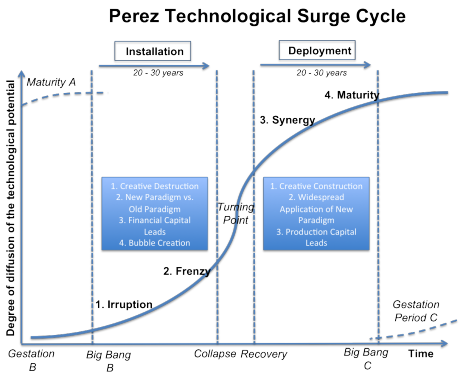
Tech Revolutions & Bitcoin - The Surge/Crash Cycle

Fred Wilson - Union Square Ventures

The Carlota Perez Framework

Fred (and his firm USV) is one of the most respected venture capitalists in the world today. His investments in the tech sector have been some of the best, and even those unfimilar with the industry will recognize a surprisingly large number of companies with they look through USV's portfolio. Fred has been focusing a lot on Bitcoin and blockchain technology lately, and this post of his was inspired by a combination of Perez's work on technology revolutions and a recent post* by William Mougayar on the potential for a bitcoin industry (not currency) bubble.

(original post on Fred's blog)

Key Points:
  • Every surge of technological innovation is marked by two phases: 
    • Installation/Infrastructure - railways, server systems, the mining network
    • Deployment/Adoption - development of the US west, adoption of the internet, ???
  • We don't know where we are with Bitcoin, but history shows us that there will be a crash.
  • There are three primary parties that could be affected by a crash
    • Bitcoin price (definitely)
    • Bitcoin companies (likely)
    • Capital markets (less likely)
http://avc.com/wp-content/uploads/2015/02/perez-cycles-final.png
Wilson's Conclusion:
The best way to manage this scenario is to invest in the post-crash cycle. Go for the long term stability that adoption of a technology will offer. Carlota says "Nothing important happens without crashes"; play for the post-crash market.

Key Takeaway:
The short-term pre-crash market, in my opinion, is mining. Right now we're seeing a widespread crash in what was for a short time a very profitable business - large scale Bitcoin mining operations. Cloud mining is being shut down across the board and electricity costs are squeezing profitability.

We're seeing unparalleled investment in bitcoin companies (Xapo, Blockchain, Coinbase). This very well could be the time for a crash. The question is, who has played for the post-crash market? My moeny is on Coinbase.

*You can read my break down of Mougayar's post here

Don't Contort Your Org Chart

Allen Morgan - Mayfield Fund

Don't Contort Your Org Chart

Morgan has been around for a while, and he likes to go by the title of "startup sherpa" with the companies he is involved with (Klout, Indiegogo, Compass). Morgan's strength lies in taking good ideas from the beginning, to an operating startup. His work at Idealab was primarily helping to run an incubator for ideas spawned by Idealab CEO Bill Gross.

(original post from Morgan's blog)

Key Points:

  • "Founder" is not a functional title. It doesn't mean anything. Once your company gets past the very early stages everyone should re-think what their role really is.
  • "Chairman" is unfit for early stages. There are rare situations when bringing in a high profile chairman who will actively contribute is useful, but usually this is not the best route.
  • Early stage ventures with defined CEO/Chairman/COO roles are a red flag to VCs. It looks like people care more about ego than product.

Takeaway:
Titles don't matter. Hard work matters. Building a detailed org chart before your company needs it is a sign that ego matters more than productivity. Stay away from defining roles until it's needed (your company is too large to operate without defined roles), and even then don't put more effort into it than is necessary (you don't need a senior vice-president in a company of 15). 

Friday, February 6, 2015

Software is Eating the World

Marc Andreessen - Andreessen Horowitz

Software is Eating the World

*This is a historic essay written in 2011 by one of the greatest names in Venture Capital. Over the last four years we can look back and see many of Marc's predictions coming true around us. The taxi industry is being undone, in spite of the regulatory environment protecting it, by wonderful services like Uber and Lyft. Airbnb is providing a new level of efficiency and variety in what used to be a restrictive hospitality business. In 2011 the table was being set, and today in 2015 software is on its second course, with more to follow.

(original post from the Wall Street Journal)

Key Points:
  • The world is beginning to be run by software.
  • The cost of starting a software company is drastically smaller than it was 10 years ago
  • The internet has destroyed longstanding business and created many more. (Borders & Amazon)
  • Google
  • Literally every industry is being reinvented through software.
    • Square, Paypal
    • FedEx
    • Cars
    • Healthcare and education are next!
  • Every industry must assume a software revolution is coming.
  • New companies are going to engage in epic battles with the huge firms of today (2011)
  • Education is lagging so far behind. Software engineers are in high demand with huge salaries and multiple job offers even during the recession.

Andreessen's Conclusion:
Software is fundamentally changing the way our world works, and no incumbent is safe.

Takeaway:
  • Learn to program
  • Be on the lookout for friction in any system. Friction represents opportunity that software can usually help.
  • It's going to be an exciting decade. :)

Managing for Progress

Tomasz Tunguz - Redpoint

Why Managing For Progress is So Important

(original post from Tunguz's blog)

Key Points:
  • Great managers focus on progress.
  • Feeling fulfilled at work comes from meeting goals
  • Good managers craft roles and positions that enable this goal oriented fulfillment
  • Loss aversion suggests that failing diminishes happiness by twice as much as succeeding increases it
Tunguz's conclusion:
Progress is the antidote to burnout. As a leader you should work to increase individual's win:setback ratio. This will increase team happiness and general well being.

Takeaway:
  • Put people in positions to succeed more than they fail.
  • Actively craft roles and systems that promote goal oriented success.

How to give feedback

Ben Horowitz - Andreessen Horowitz

Making Yourself a CEO

(original post from Ben's blog)

Ben Horowitz is one of the most well known venture capitalists in the US right now. He recently published a book (The Hard Thing About Hard Things) and is an investor in many successful companies like AppNexus and Asana. 

Keys to communicating feedback:
  • Authenticity - Ben mentions how fake the "Shit Sandwich" method of layering in criticism between compliments sounds, especially with more experienced employees.
  • Come from the right place - Make sure people understand that you're saying this because you want them to succeed. Make them understand that you're in their corner.
  • Don't get personal - give feedback, and act decisively. Don't "prep people for firing". 
  • Don't clown people - Calling people out in front of their peers only makes them hate you.
  • Everyone is different - Feedback needs to be given differently to different people.
  • Be direct, not mean - Don't conceal criticism <"There are no two words in the English language more harmful than 'good job'." - J.K. Simmons (Whiplash)> Offer genuine unveiled analysis when necessary.

Horowitz's conclusion:
Feedback is a dialogue. It needs to be a continuous, high-frequency, and properly framed conversation with everyone you're leading. People need to feel comfortable talking about what each other are doing wrong. Continuous personal improvement should be a cultural thing.

Takeaway: 
Feedback is a dialogue. Make it pervasive and make sure everyone is comfortable with it. It shouldn't be okay to screw up, but no one should be shamed into hiding it. Building this culture feels unnatural. You're interacting with people in a way that you don't in any other setting, but doing so improves the company by making room for improvement. 

Thursday, February 5, 2015

Hiring vs Training

Fred Wilson - Union Square Ventures


Hiring Mobile Engineers vs Training Engineers on Mobile


(original post from Fred's blog AVC)

Fred Wilson is one of the most famous venture capitalists in the world today for two reasons. First, his firm USV makes solid investments. (They were early investors in companies like Twitter, Tumblr, and Kik.) Second, he has posted quality content to his blog every day without fail since 2003, giving him one of the strongest blog followings on the internet.

Scenario:

  • Many Web first companies in the USV portfolio have struggled to adapt to "mobile first"
  • The usual, and sub-optimal approach often taken is to build specifically mobile teams
    • Mobile managers/designers/engineers are in high demand and short supply
    • Two teams end up building what should be one product
    • synchronizing teams is hard
  • The harder but more effective approach is to train your existing team in mobile.
    • not possible for very young startups
    • getting the right training for the right people can be hard
Wilson's conclusion:
The fundamental issue here is whether or not to hire from the outside, or invest in your current team. Jerry Colonna once advised Wilson that the best companies to invest in and work for are those that invest in their employee's development. Get your best people to learn new tricks.

Takeaway:
  • Invest in your team. You create longer term value when you invest in the people you have already. It's not always the easiest thing to do, but it's highest quality option.
  • Hiring (and outsourcing) causes friction. Smaller teams have fewer communication barriers. A highly skilled small team of full stack engineers is better than a scattered team that works on loosely related projects.

Greatness & The Value in Budgeting

Phin Barnes - First Round

I am a witness to greatness

(original post from Barnes' blog Sneakerhead VC)

Scenario:
  • Company X is doing amazingly well.
  • At an investors meeting the CEO apologizes for not having the 2015 budget ready yet.
  • Investors are okay with the delay since they know the company is doing well.
  • Investors joke about the pain of budgeting.
  • CEO of company X surprises investors, silences them in fact, when he expresses excitement about getting the budget ready.
"I am excited to build out the budget because it will save us a ton of money. The reason you create a budget is to drive financial literacy around company priorities into the organization. The budget will empower every employee to make better decisions and help us to be more efficient as a business. This is critical to our success." -- CEO
Barnes' conclusion:
I've always thought of budgets as constraints, but this guy thinks of them as empowering. This mentality is one that embodies greatness.

Takeaway:
  • Budgets are empowering. When done well, they decrease uncertainty and provide clear financial boundaries within which your team can operate. (So get your budget right.)
  • To be great is to look past the status quo and see value in things others might shrug off, or, in this scenario, see as a constraint.